What the Smyrtos did before the boarding
On 14 June 2026, Royal Marines boarded the tanker Smyrtos in the English Channel. It was the first UK seizure of a Russian shadow-fleet vessel. Its captain was charged under UK sanctions law; a trial is set for 15 December 2026. A
The boarding is public record. What the vessel did before it is not — until now.
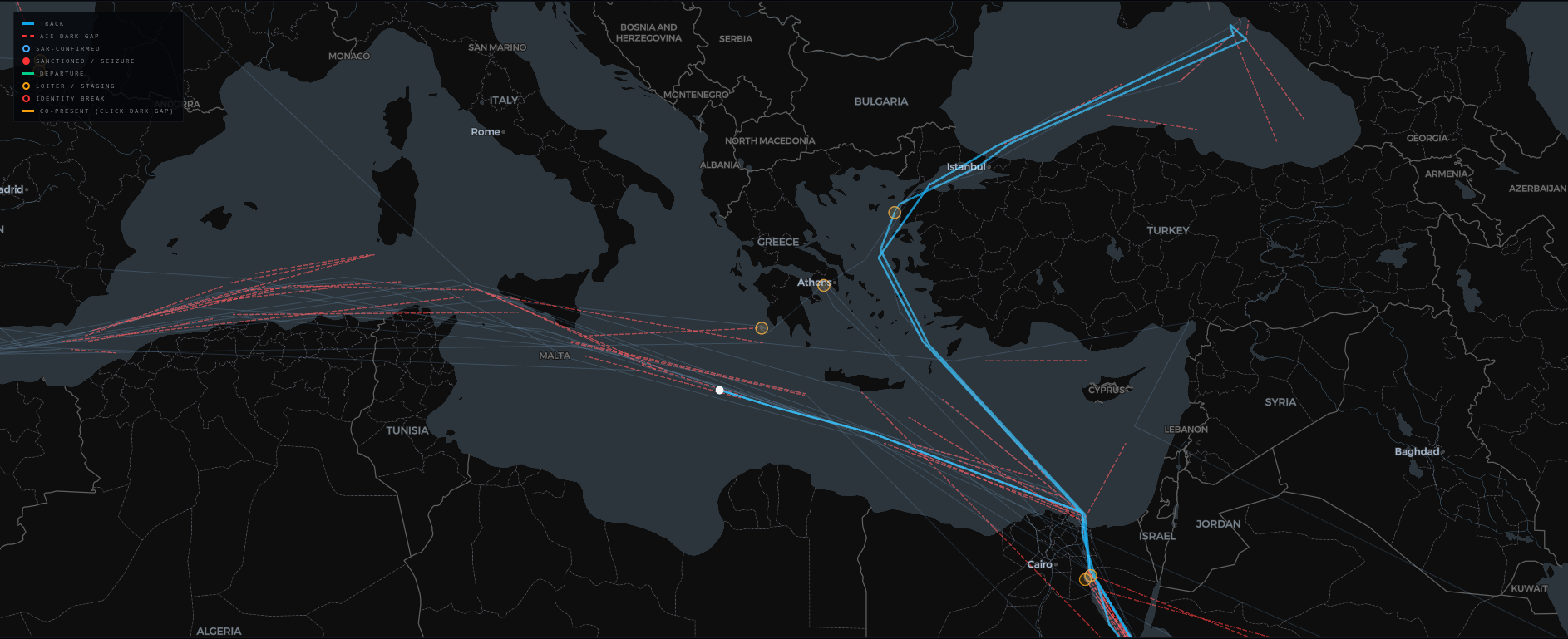
The reconstruction
On 13 March 2022, the Smyrtos lay stationary off Skagen, at the gateway between the North Sea and the Baltic. AIS shows one vessel rafted alongside it: the crude oil tanker Monte 1 (IMO 9297553). The two hulls held station about 2 metres apart for roughly 42 hours. B Both are Cameroon-flagged, comparable in size, aging Aframax-class tankers. Stationary, alongside, in open water, for the better part of two days — that combination is the signature of a ship-to-ship oil transfer, not a passing encounter.
Yet Monte 1 was not designated by any authority until June 2025, when the UK acted, followed by the EU, Switzerland, Canada, and Australia. A Ukrainian government records (HUR, an advisory identification rather than a binding designation) separately describe Monte 1 as a tanker that disables AIS near Russian Baltic ports — the same behavior, the same waters, as the encounter above. C A designation is a snapshot of a vessel's status today. A counterparty it met years earlier doesn't show up in that snapshot unless someone reconstructs the history. This is that reconstruction.
17 June 2025 — United Kingdom
The first designation of Monte 1 — three years and three months after it rafted alongside Smyrtos off Skagen.
21 July 2025 — European Union
EU Council Official Journal listing, five weeks after the UK. The same date the Eventin — a hull with no other connection to this reconstruction — is designated by the UK, in a separate action.
12 August 2025 — Switzerland
Three weeks after the EU.
24 February 2026 — Canada
Seven months after Switzerland.
24 February 2026 — Australia
The same date as Canada's listing — the fifth binding designation, coordinated or coincidental, we don't assert which.
9 June 2026 — Ukraine (advisory)
An advisory identification, not a binding designation, recorded separately.
Data table
| Date | Label | Status |
|---|---|---|
| 17 Jun 2025 | United Kingdom (FCDO) | Binding designation |
| 21 Jul 2025 | European Union | Binding designation |
| 12 Aug 2025 | Switzerland (SECO) | Binding designation |
| 24 Feb 2026 | Canada | Binding designation |
| 24 Feb 2026 | Australia (DFAT) | Binding designation |
| 9 Jun 2026 | Ukraine (GUR) — advisory | Binding designation |
A short video walks through it visually.
Evidence and confidence
Each finding above carries a grade for how it was established, not how serious it is.
| Claim — evidence basis | Grade |
|---|---|
| Stationary, alongside, ~2 metres apart, ~42 hours off Skagen, 13 Mar 2022 — read from the vessels' own AIS position reports | B |
| Boarded in the English Channel, 14 Jun 2026 — first UK Russian shadow-fleet seizure; captain charged under UK sanctions law, trial 15 Dec 2026 | A |
| Monte 1 designated by five authorities, 17 Jun 2025 → 24 Feb 2026 — three years after the Skagen encounter | A |
| Ukrainian HUR advisory description of Monte 1 as an AIS-disabling tanker near Russian Baltic ports — a pattern match to the Skagen encounter, not confirmation of it | C |
What would prove this wrong
Three specific, checkable ways this reconstruction could be wrong or overstated:
- Skagen turns out to be an ordinary rafting spot. The "signature of a transfer" reading rests on stationary, alongside, in open water, for the better part of two days being an unusual combination. If Skagen is shown to be a routine anchorage where unrelated vessel pairs raft up for reasons that have nothing to do with cargo — waiting on weather, crew changes, bunkering — the transfer reading weakens to a coincidence of timing.
- The "2 metres apart" reading is a resolution artifact. That figure comes from the two vessels' own reported AIS positions, not a physical measurement. If closer review shows normal AIS position error at that range could produce the same reading for two vessels that were not actually alongside, the proximity claim needs revising down.
- The Ukrainian HUR characterization of Monte 1 doesn't hold for this specific encounter. We cite HUR's advisory description of Monte 1 as an AIS-disabling tanker as a behavioral pattern match, not as confirmation of this event. If that characterization is later revised or shown not to apply to the 2022 window, the pattern-match argument — not the underlying AIS data — is what weakens.
Method
The reconstruction is built from the vessel's own AIS transmissions. It is anchored on the IMO number, the one identifier that survives a name or flag change. Where an independent source exists to check a finding against, the finding is checked against it. Where AIS coverage has a gap, the gap is reported as a gap and nothing is inferred from it. The tests that separate a raft-up from routine port traffic are proprietary and are not described here.
The criminal case against the vessel's captain is active. This reconstruction is offered as factual background. The analysis reports what the vessel did; what it means is for the reader, the court, or the reader's own counsel to determine.
Use
This reconstruction and video are free to use, but you must credit AIS Dark.
The full case file is free too. It covers the ownership and management history, four ship-to-ship events, and the full flag and network record. Enter an email below and we'll send it over.
Want the same reconstruction on a different vessel? Get in touch.
As of 29 July 2026. Case AISD-SMYRTOS-01.
Want the full case file on the Smyrtos?
One email, sent once. No list, no follow-up spam.